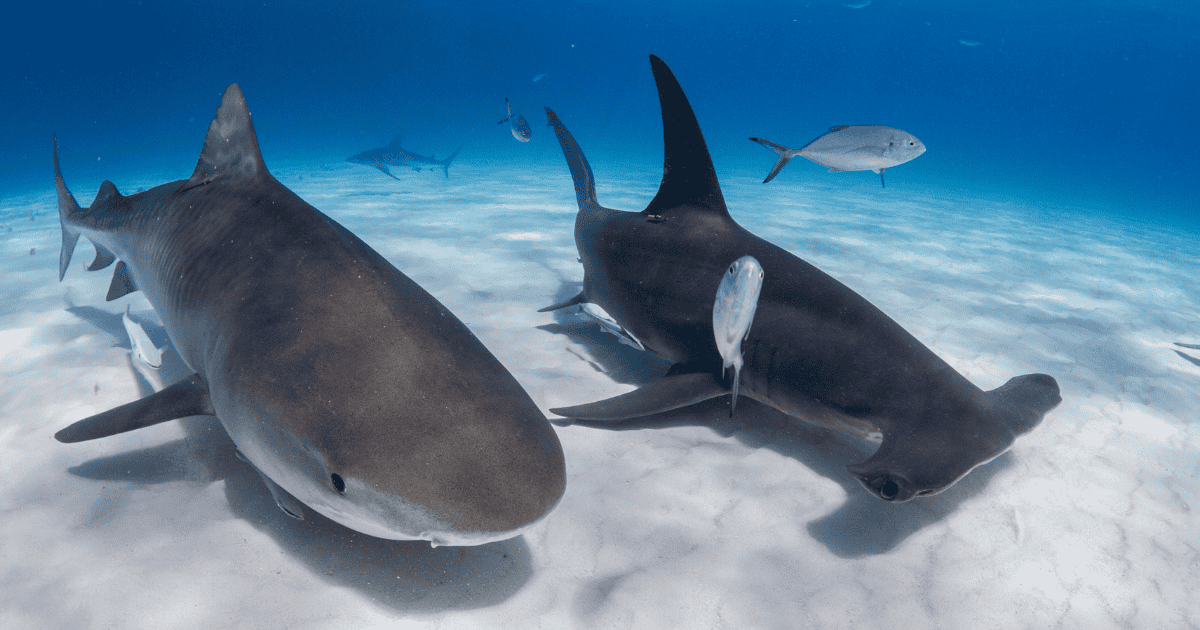
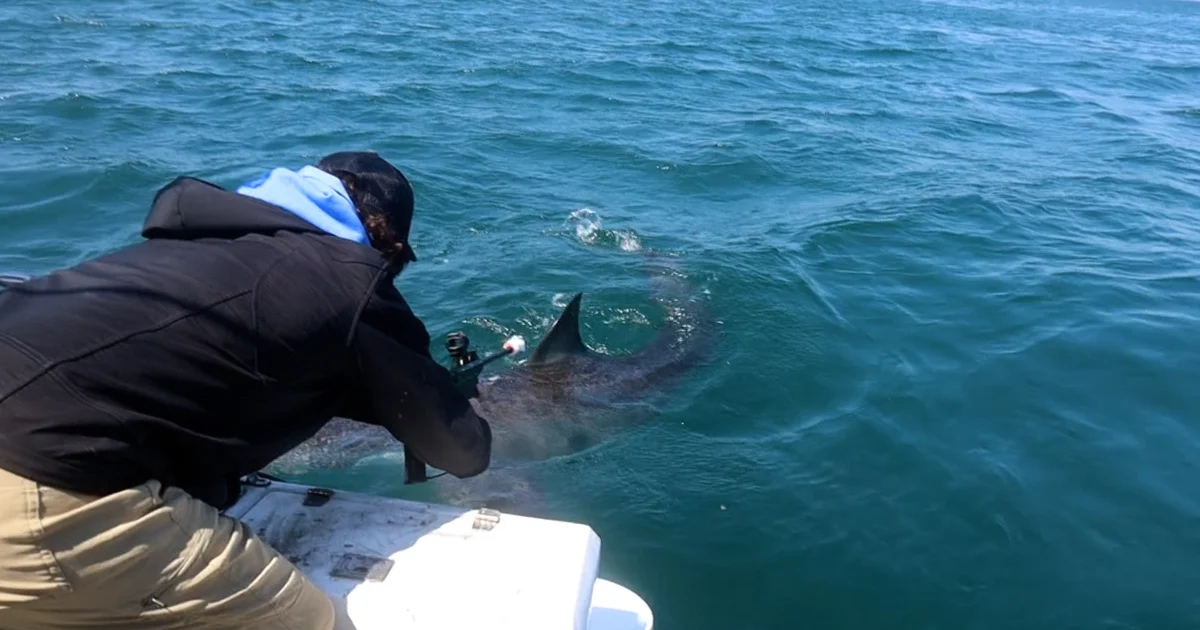
Shark science in 2025 delivered major breakthroughs and exciting discoveries. New research reshaped our understanding of shark behavior, evolution, migration, cognition, and how ocean ecosystems change when apex predators disappear. From newly discovered species to advanced genetic analyses and surprising behavior, check out these 14 Groundbreaking 2025 Shark Discoveries each of which contributed to making 2025 one of the most exciting years ever for shark research.
Curated by Dr. Neil Hammerschlag, below are 14 of some of the most fascinating shark discoveries of the year— each linked to the primary scientific publication where available.
1. Sharks May Engage in True Play Behavior
Sharks were observed repeatedly manipulating objects with no food reward, meeting scientific criteria for genuine play. This finding adds to growing evidence that sharks possess complex cognitive abilities. Check out this video and judge for yourself if you think the sharks are playing with the pool toys.
2. Ocean Acidification Can Erode Shark Teeth
A 2025 experimental study found that acidic ocean conditions can weaken and erode shark teeth, causing cracks, corrosion, and loss of sharpness. While sharks constantly replace their teeth, increasing acidity may still impair hunting efficiency, with potential ripple effects across marine food webs.
3. Fossils Reveal Tiny Ancient Sharks the Size of a Paperclip
Scientists described Clavusodens mcginnisi, a 340-million-year-old shark species estimated to be just 3–4 inches long — about the size of a paperclip. Informally nicknamed “chipmunk sharks” for their chisel-like and crushing teeth, the species adds to evidence of surprising early shark diversity.
4. New eDNA Tool Detects Rare Hammerhead Sharks
A newly developed environmental DNA (eDNA) test offers a vital breakthrough for monitoring small-bodied hammerhead sharks, such as the critically endangered Scalloped Bonnethead and Scoophead. These elusive species inhabit turbid coastal waters where traditional visual surveys are often ineffective. By analyzing genetic traces from a simple water sample, this non-invasive tool allows researchers to pinpoint species presence and identify essential conservation hotspots without the stress of capture. Validated in Colombia, this scalable method provides the data needed to protect these overlooked sharks from local extinction.
5. Great White Shark DNA Reveals an Evolutionary Puzzle
Genome sequencing uncovered a major mismatch between mitochondrial and nuclear DNA in great white sharks, suggesting ancient hybridization or strong sex-biased dispersal. Researchers also found that great whites were limited to a single Indo-Pacific population shortly after the last ice age, before expanding globally.
Looking to witness these evolutionary marvels up close and in person? Book our Great White Yarmouth Expedition and cage dive with Great White Sharks in Nova Scotia waters.
6. Long-Lost Sailback Shark Rediscovered After 50+ Years
The rare sailback houndshark (Gogolia filewoodi), known for its unusually tall dorsal fin, was last seen in 1973. New records from Papua New Guinea in 2020 and 2022 confirm the species still exists, offering a valuable opportunity to study this unique evolutionary lineage.
7. Mako Sharks Show Enhanced Thermoregulation During Deep Dives
Shortfin mako sharks exhibit warming rates more than ten times faster than their cooling rates. By attaching data loggers to these predators, researchers discovered they slowly lose heat during deep foraging dives but rapidly recover it in warm surface waters. This advanced thermoregulation is comparable to that of bigeye tuna and swordfish and appears to be a key evolutionary advantage. It allows makos to hunt effectively in cold depths for extended periods before quickly restoring their optimal body temperature near the surface.
8. New Species of Deep-Sea Lanternshark Discovered — and it’s Bioluminescent
A newly described lanternshark, Etmopterus westraliensis, joins the ranks of bioluminescent deep-sea sharks. Specialized organs called photophores allow it to produce light along its flanks and abdomen — a critical adaptation for survival in the deep ocean.
9. First Recorded Shark “Threesome” in the Wild
Researchers documented the first wild observation of group courtship and copulation in Indo-Pacific leopard sharks. The 90-minute event involved two males and one female engaging in a structured sequence of behaviors, previously known only from captive environments.
10. First Fine-Scale Movements of a Hybrid Shark Tracked
Scientists identified and tracked the movements of a natural hybrid between a scalloped hammerhead and a Carolina hammerhead for the first time. The hybrid displayed unique movement and diving patterns distinct from either parent species, suggesting potential ecological differences.
11. Megalodon Was Longer, Sleeker, and More Hydrodynamic Than Once Believed
New reconstructions reveal that Otodus megalodon may have reached up to 80 feet (24 meters) and was far more streamlined than previously imagined — more like a giant lemon shark than a bulky great white. This hydrodynamic shape would have maximized speed, hunting efficiency, and long-distance travel.
12. Blue Sharks Contain Color-Changing Crystals in Their Skin
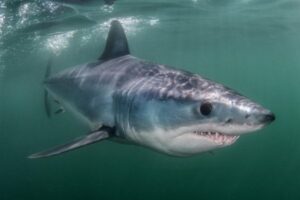
New anatomical research shows that blue sharks have microscopic guanine crystals embedded in their skin. These layered crystal structures act like tiny mirrors and light filters, producing the shark’s vibrant blue color. What’s more, changes in the spacing of these crystals — possibly triggered by environmental factors like water pressure — could enable the sharks to shift their color from blue to green or gold, offering dynamic camouflage advantages.
Did you know that blue sharks are native to Nova Scotia? These fascinating creatures are the most frequent visitors on our Halifax Cage Diving Expedition and Early Halifax Cage Diving Expedition where you can cage dive with a variety of shark species off the coast of Halifax, Nova Scotia.
13. Scientists Record First Known Shark Sounds
For the first time, scientists have recorded sounds produced by a shark — high-frequency clicks likely created by forceful snapping of the teeth. These sounds were consistently detected when rig sharks (Mustelus lenticulatus), small bottom-dwelling sharks from New Zealand, were handled by researchers underwater. Because sharks lack swim bladders and other known sound-producing organs, the clicks are believed to be a stress or startle response triggered by restraint. This discovery opens new avenues for studying shark behavior, communication, and sensory ecology.
14. Disappearance of White Sharks in False Bay Triggered a Trophic Cascade
New research has revealed that great white sharks have largely vanished from False Bay, likely due to decades of shark-net mortality and some predation by orcas. Their loss has caused increases in Cape fur seals and sevengill sharks as well as changes in their behaviors, with consequential declines in the species those predators feed on — providing rare real-world evidence of a cascading food-web shift following the loss of an apex predator.
Shark Science Is Evolving Faster Than Ever
2025 proved to be a landmark year for shark research, revealing new species, new behaviors, and new insights into how sharks shape marine ecosystems. With advancing technologies — from eDNA to satellite telemetry — future discoveries are poised to be even more transformative.
You can always check out our blog for more interesting content about sharks, shark science, and conservation, and even learn about our cage diving expeditions.
Many students imagine the daily life of a shark scientist as tagging Great Whites every afternoon, diving constantly in crystal clear water, or travelling to exotic locations. While those experiences can certainly be part of the career, the real path regarding how to become a shark researcher is much broader, more analytical, and more flexible than most people realise.
If you are sitting in a classroom wondering how to become a marine biologist, it is important to understand that the path is much broader and more analytical than it appears on television. Check out these insights from a shark researcher and marine biologist.
This Shark Week, take your fascination even deeper. While millions tune in to Discovery Channel for thrilling footage of the ocean’s top predators, we’re celebrating
To provide the best experiences, we use technologies like cookies to store and/or access device information. Consenting to these technologies will allow us to process data such as browsing behavior or unique IDs on this site. Not consenting or withdrawing consent, may adversely affect certain features and functions.
Functional
Always active
The technical storage or access is strictly necessary for the legitimate purpose of enabling the use of a specific service explicitly requested by the subscriber or user, or for the sole purpose of carrying out the transmission of a communication over an electronic communications network.
Preferences
The technical storage or access is necessary for the legitimate purpose of storing preferences that are not requested by the subscriber or user.
Statistics
The technical storage or access that is used exclusively for statistical purposes.The technical storage or access that is used exclusively for anonymous statistical purposes. Without a subpoena, voluntary compliance on the part of your Internet Service Provider, or additional records from a third party, information stored or retrieved for this purpose alone cannot usually be used to identify you.
Marketing
The technical storage or access is required to create user profiles to send advertising, or to track the user on a website or across several websites for similar marketing purposes.
To provide the best experiences, we use technologies like cookies to store and/or access device information. Consenting to these technologies will allow us to process data such as browsing behavior or unique IDs on this site. Not consenting or withdrawing consent, may adversely affect certain features and functions.
Functional
Always active
The technical storage or access is strictly necessary for the legitimate purpose of enabling the use of a specific service explicitly requested by the subscriber or user, or for the sole purpose of carrying out the transmission of a communication over an electronic communications network.
Preferences
The technical storage or access is necessary for the legitimate purpose of storing preferences that are not requested by the subscriber or user.
Statistics
The technical storage or access that is used exclusively for statistical purposes.The technical storage or access that is used exclusively for anonymous statistical purposes. Without a subpoena, voluntary compliance on the part of your Internet Service Provider, or additional records from a third party, information stored or retrieved for this purpose alone cannot usually be used to identify you.
Marketing
The technical storage or access is required to create user profiles to send advertising, or to track the user on a website or across several websites for similar marketing purposes.
U.S. Customers Save Big When Booking in Canadian Dollars 🇨🇦 → 🇺🇸
This table is an example and does not reflect current pricing.
All prices on this site are in Canadian dollars (CAD). U.S. customers benefit from favourable exchange rates. Approximate savings are shown below based on recent historical USD/CAD rates between $0.69 and $0.74.
📊 Cage Diving – Halifax
📊 Great White Expeditions
Exchange rates fluctuate daily. USD amounts shown are estimates. Check with your bank or card provider for the current rate. No additional international fees are charged by Atlantic Shark Expeditions. Early Bird and promotional pricing available for limited time only, there is no guarantee promotional pricing will be available at the time of booking.
Stay informed about ASE news and upcoming expeditions